
France is breaking all records. Two successive heatwaves within a matter of weeks, and the effects ripple through every aspect of daily life. The changes happening around us are impossible to ignore.
Summer is normally a time for enjoyment, festivals, open-air music. This year, the extreme heat has had a direct impact on all of that, with some events cancelled outright.
For datacenters, the story is much the same. You might assume that everything is planned for, that the major operators have it all under control. But when a datacenter struggles, entire sections of information systems can go down with it, and the business consequences are very real.
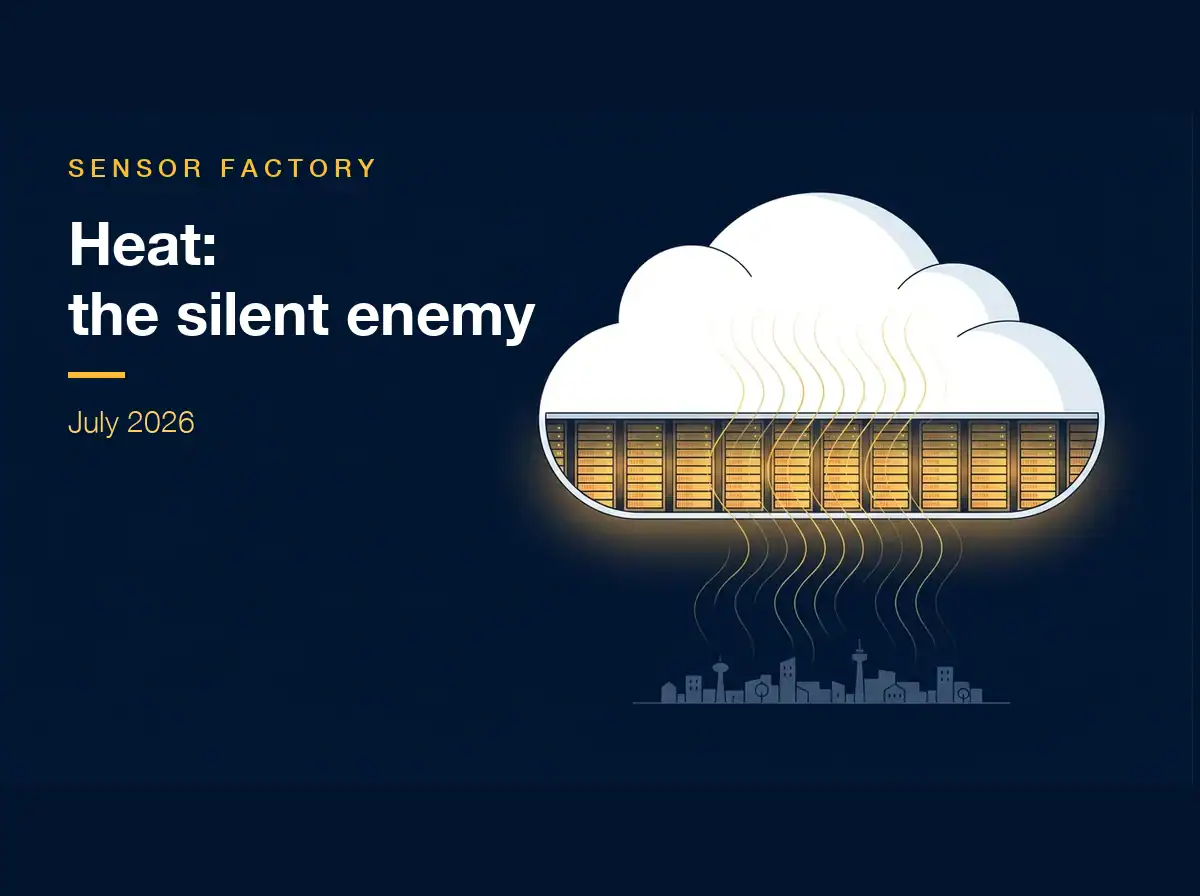
The cloud runs on machines. Machines that get hot.
The misconception is stubborn: “my servers are in the cloud, I’m protected.” Protected from what, exactly? The cloud is rooms full of physical machines, subject to the same constraints as any server room. Whether it’s a small IT closet on a client’s site or a datacenter spanning thousands of square metres, the challenge is identical: when it’s 40°C outside, cooling systems have to push heat out into air that’s already saturated. The margin shrinks. And when the margin disappears, the outage happens. The difference with the cloud is that you don’t operate the room. But outages happen there just the same.
Recent examples are plentiful. In May 2026, AWS had to shut down a datacenter in Northern Virginia following a cooling system failure. The resulting temperature rise triggered a power cut affecting several servers and storage volumes. Coinbase, among others, was impacted. Yesterday, OVH experienced an outage at its Gravelines site in France, caused by a cooling system issue. Servers remained unavailable for several hours.
These aren’t isolated incidents. They’re a trend. And I’m afraid it’s only going to get worse.
Environmental monitoring: a component too often overlooked
We monitor CPU, RAM, disks, network interfaces. We often forget to monitor the room itself.
Temperature and humidity are nonetheless two critical indicators. International standards such as those from ASHRAE define optimal operating ranges for equipment. Outside these ranges, the risks are very real: electrostatic discharge, condensation, corrosion, accelerated hardware ageing.
The question of sensor placement is more nuanced than it might seem. A sensor fitted in a chassis or on a network device gives a local reading, useful for diagnosis. But an ambient sensor in the room raises the alarm earlier, when the overall temperature begins to drift before the equipment itself feels it. Both are complementary. One monitors the environment, the other monitors the equipment. Relying on only one means having a blind spot.
Compact, non-invasive sensors that integrate easily into existing monitoring platforms are widely available today. Solutions like Yoctopuce, for example, make it possible to deploy environmental sensors directly in the room or on the racks, and to integrate them natively into the supervision stack. This is something we implement for our clients, and it works well.
What environmental monitoring needs to do is not fire an alarm when the room hits 38°C. It needs to alert when the ambient temperature drifts progressively from 21°C to 26°C over two weeks. As I mentioned previously in the context of a CPU that saturates a little longer each week without ever breaching its alert threshold: it’s the weak signal that needs to be caught, before the hard failure arrives.
Weather is now an architecture parameter
Heatwaves are no longer exceptional events. They are predictable, recurring, and their effects on digital infrastructure are documented and measurable.
A recent study on French datacenters found that 26% of the projects analysed are considered high climate risk as of 2026. The risk of climate-related hardware damage is expected to increase more than fourfold by the end of the century.
Treating heat as an operational parameter is no longer optional. Monitoring the physical environment of your server rooms, setting meaningful alert thresholds, catching drift before it becomes a failure: these are today’s issues, not tomorrow’s.
Festivals cancelled because of a heatwave are painful. An infrastructure that goes down on a Friday evening in August because the air conditioning failed and nobody saw it coming is even more so.
To go further on our approach to monitoring and observability, take a look at our articles on behavioural analysis of monitoring platforms, which I published recently, and on the broader vision of observability and infrastructure by Matthieu.