
Ask anyone today what counts as the most advanced thing in tech and they’ll say “generative AI”. Fair answer. But there is a rung above it, a territory where the AI models you use every day meet a machine of a radically different kind: the quantum computer. And the fantasy is never far behind, coupling the power of large language models with a quantum computer, wouldn’t that be where the famous “super intelligence” finally springs from?
Spoiler: we aren’t there. Not even close. But the progress is far more concrete than people think, to the point that you may already have benefited from a little quantum without knowing it, and that the security of your web connections is changing because of it. At Sensor Factory, we spend our days in the world of monitoring, data and IT infrastructure, so this subject speaks to us. So we turned it into a summer deep dive. Settle in, we’ll break it down, no needless jargon and no overselling.
- A quantum computer isn’t a faster PC: it’s a different kind of machine, built for optimisation, simulation and sampling.
- There is no reliable machine yet: the era is “noisy” (NISQ), and the advertised qubit count matters less than the physical-to-logical qubit ratio.
- Quantum and AI are two distinct topics: AI already helps build the machines, and quantum might one day help AI (an energy angle still to be confirmed).
- What already concerns you: post-quantum cryptography. NIST standards have existed since 2024; the migration should be anticipated now.
First: a quantum computer isn’t “a faster PC”
That’s the first thing to get straight. A quantum computer isn’t a classical computer on steroids. It’s a machine of a different nature, built to solve different problems. Some would even say we should not call it a “computer” at all.
Back to basics. Classical computing manipulates bits: 0s and 1s, binary information, it’s one or the other. Quantum computing manipulates qubits, which can be in a superposition of 0 and 1, roughly “a bit of 0 and a bit of 1 at the same time”. Technically, a qubit carries a probability distribution of being measured as 0 or as 1.
The clearest intuition is the maze. To get out of it with a classical computer, you test the paths one by one; depending on the size of the maze, the tree of possibilities explodes exponentially and it can take a very long time. The quantum idea is to explore a superposition of paths at once, and to exploit the interference between those possibilities to make the right answer stand out. Add qubits and the state space climbs in powers of 2: with 10 qubits, you manipulate a superposition from 0 to 2¹⁰ − 1, that’s 1,024 simultaneous states.
Then comes the awkward question: if “everything is tested at once”, how do you get the right answer back? That’s the whole subtlety. You chain quantum logic gates designed so that, in the end, the probabilities collapse toward the solution: the right answer becomes the most probable state, and you read it by measuring. The genius of a quantum algorithm is orchestrating this interference, it’s not magic, it’s mathematics.
Worth remembering, so as not to fool yourself: a QPU (Quantum Processing Unit, by analogy with the CPU and the GPU) isn’t good for everything. Just as a GPU has its specialty, the QPU has its own: optimisation, sampling, simulation of quantum systems (chemistry, materials). For everything else, your good old processor remains unbeatable.
The heart of the problem: noise and decoherence
This is why you should read the loud announcements with a grain of salt. We live in what is called the NISQ era (Noisy Intermediate-Scale Quantum): mid-sized machines and, above all, noisy ones. Concretely, when you run a computation, you’ve no guarantee that it’s really that computation that took place. The analogy that works: you ask for 1 + 1, what actually happens is 1 + 4, you measure 5, and you don’t know what went wrong.
Where does this noise come from? From the very fragility of the quantum state. Remember Schrödinger’s cat: as long as you don’t open the box, it’s “both” alive and dead. For a qubit it’s the same, you can’t observe it during the computation without destroying it; you only measure at the end. The problem is decoherence: as soon as a qubit interacts with its environment (a vibration, a temperature change, a stray photon), it loses its quantum character, becomes “classical” again, and the information is lost. Measurement is an interaction you trigger deliberately; decoherence is the same thing, but suffered.
That’s why superconducting-qubit machines have to be cooled to a few millikelvin, a hair above absolute zero, inside imposing cryostats: the slightest thermal agitation would collapse the qubits. And the more qubits you add, the more chances for decoherence you create, hence more risk of error. Scaling isn’t just a matter of “building bigger”.
Counting qubits means (almost) nothing
This is the most useful passage to armour yourself against marketing. The race is often run through announcements about the number of qubits. Except those qubits are, for the most part, physical qubits: qubits with errors. The real Grail is the logical qubit, an error-corrected qubit, therefore reliable, obtained by spreading the information across several physical qubits using an error-correcting code. That physical-to-logical ratio is the metric that actually counts, and it can range from a few dozen to a hundred physical qubits for a single logical qubit.
The good news is that 2024-2025 marked a credible turning point on this front. In late 2024, Google unveiled its Willow chip (105 qubits) and, above all, a key demonstration: as you grow the error-correction lattice, the error rate decreases instead of increasing. This is what is called going “below threshold”, the first experimental proof that the more qubits you add, the better you correct, a prerequisite for ever hoping to build reliable machines. For its part, IBM published in June 2025 a detailed roadmap toward “Starling”, presented as the first large-scale fault-tolerant quantum computer, targeted for 2029, with on the order of 200 logical qubits and more frugal error-correcting codes (qLDPC). Two strategies, one shared heading: fault tolerance.
Translation for the reader in a hurry: we’re no longer in pure promise, but we aren’t yet at the useful, reliable machine. We’re in the engineering of scaling up, the least glamorous and most decisive part.
The number that matters isn’t the qubit count in the headline, but the physical-to-logical qubit ratio. As long as it takes 50 to 100 physical qubits for a single reliable one, an “N-qubit” announcement says almost nothing about what the machine can really do.
A zoo of technologies, and no obvious winner
There isn’t “one” quantum computer, but several families that share only the fact of exploiting quantum particles:
- Superconducting: IBM, Google. Fast, but at the cost of millikelvin cryostats.
- Trapped ions: IonQ, Quantinuum. Very “clean” and stable qubits, but slower operations.
- Neutral atoms: Pasqal (France), QuEra. Promising for scaling up.
- Photonics: PsiQuantum, Xanadu, Quandela (France). Computing with photons, often at room temperature.
Understanding the challenges specific to each approach takes genuinely advanced physics, and that’s what makes the sector hard to read from the outside. Will one technology crush the others? A few years ago, that was the assumption. The current consensus is more nuanced: some will fail, several will succeed, and each will probably specialise on a class of problems. We’re heading toward coexistence rather than a single winner. It all remains uncertain, the real answer will be written over 3 to 5 years.
Note in passing that Europe and France aren’t mere spectators: Pasqal, Alice & Bob, Quandela and others hold credible positions, with an openly assumed sovereignty stake. More on that shortly.
Quantum and AI: two marriages not to be confused
This is the most misunderstood point. There’s no “quantum and ML”, there are two distinct entanglements.
1. AI in service of quantum. Machine learning helps build better machines: calibrating and characterising temperamental hardware, compensating for manufacturing imperfections, and above all optimising error correction (decoding in real time which qubit “faulted” is an inference problem at which ML excels). It isn’t spectacular, but it’s a very real use, already in production at several manufacturers.
2. Quantum in service of AI. The idea: spot the problems where AI struggles, too much data, too much time, too much energy, and see whether a QPU can help. And this is where the argument that should interest any large-scale data player hides: energy. Training and running AI models devours a colossal amount of electricity, and the trajectory of data centres is worrying. Several works argue that certain compute building blocks, driven by quantum algorithms (or hybrid architectures), could reach an energy advantage, doing the same thing for far fewer watts, potentially before the raw speed advantage. It’s a lead, not a certainty: other studies remind us that quantum infrastructure (cryogenics, control) also has a cost, and that the net balance remains to be proven. Well worth watching closely.
In both cases, the credible future is hybrid: the bulk of the computation on classical CPUs/GPUs, and only the portion that benefits offloaded to the QPU. That’s why QPUs are now moving into high-performance computing (HPC) centres and integrating with their interfaces: several European supercomputers already host quantum accelerators, operated alongside GPUs. The QPU as a specialised co-processor, not as a replacement.
The hidden side: the QML hype
This is the most lucid passage, and it should speak to anyone who does serious tech watch. Quantum Machine Learning (QML) generates enormous enthusiasm, and the subject is very marketable, in a sector that attracts a lot of capital. The result: part of the literature shows spectacular… but fragile performance. Results obtained a single time, with no standard deviation or average, blurry data splits, no published code, no reproducible repository. You read it, you’re impressed, then you doubt. The clean academic format lends a credibility that’s not always deserved, especially at a time when peer review is under strain and you can put just about anything on a preprint server.
Several recent analyses temper things quite bluntly: to date, no generalised quantum advantage has been proven in machine learning on classical data, and one stubborn technical lock is the input/output bottleneck: loading large volumes of classical data into a quantum state is expensive and can cancel out any theoretical gain. In other words, “quantum that supercharges LLMs”, for now, is mostly a promise.
This isn’t a hit piece: there are real, interesting results, including work (notably on IBM’s side) that mathematically demonstrates a potential advantage on certain carefully chosen families of problems. But the right reflex, ours, at Sensor Factory, on AI as on quantum, comes down to one simple rule: distrust anything that isn’t reproducible. Before taking a spectacular result at face value, we look at the method: are the code and data published? Was the experiment repeated, or obtained just once? Are the classical baselines serious, or rushed to the point of artificially inflating the quantum advantage? It’s tedious, it isn’t sexy, and it’s exactly what separates useful tech watch from the buzz.
What already works, for real (and why it concerns you)
Enough of the conditional. Two areas where quantum has a concrete and immediate impact, both on the security side, a field that speaks directly to a monitoring and IT integrator.
Quantum random numbers (QRNG). Generating true randomness is surprisingly hard in classical computing: “pseudo-random” generators are deterministic, and some are so predictable that a few draws are enough to guess what comes next. By relying on the fundamental indeterminism of quantum measurement, QRNGs produce very high-quality entropy, with certified, genuinely unpredictable randomness. It’s already commercialised and deployed: hosting providers and security vendors integrate it to strengthen keys and certificates. A sober use case, but one that runs in production today.
Post-quantum cryptography (PQC). This is the subject not to miss, and it isn’t waiting for quantum computers to be ready. Shor’s algorithm shows that a sufficiently powerful quantum machine could break RSA encryption (which rests on the difficulty of factoring large numbers) and much of what secures the web. The machine capable of doing it at real scale doesn’t exist yet, but the threat is taken very seriously, because of the “harvest now, decrypt later” risk: an attacker can capture encrypted data today to decrypt it tomorrow. That’s why the NIST finalised in August 2024 its first post-quantum standards (FIPS 203 / ML-KEM, FIPS 204 / ML-DSA, FIPS 205 / SLH-DSA), algorithms designed to resist a future quantum computer. Migrating to these standards is a project that starts now in IT departments.
The “harvest now, decrypt later” threat is already here: data captured today could be decrypted by a future quantum computer. NIST’s post-quantum standards have existed since August 2024. Inventorying your sensitive systems and planning their migration is a project to open now, not in ten years.
These two examples share one merit: they don’t require waiting for the “useful” quantum computer to have an impact. The first exploits quantum today; the second protects against it in advance.
What we take away at Sensor Factory
Let’s be honest: for most IT teams, quantum is still a watch topic today, not this quarter’s project. With one exception, and it’s a big one: security. Post-quantum cryptography isn’t science fiction, the standards have existed since 2024, and inventorying then planning the migration of sensitive systems is an IT governance topic to open today, not in ten years. It’s the one point in this deep dive that calls for concrete action in the near term.
The rest, we follow as tech watch, in the good sense of the term. Energy efficiency is a lead to watch: the idea that the energy advantage might arrive before the speed advantage is worth keeping in mind for tomorrow’s infrastructure, net balance to be checked. And quantum is a good training ground for a reflex that holds well beyond it: believe nothing that isn’t reproducible. That, ultimately, is what interests us most, separating signal from noise.
The final word? Quantum isn’t a field you step into with a snap of the fingers; it takes some time to make it your own. And that’s precisely why the moment is ideal. The machines aren’t reliable yet, the community is only beginning to organise, the tools are opening up. Good news: several manufacturers now give access to real quantum processors via the cloud, often with free credits, enough to send a first little algorithm to a real machine and form your own opinion. That may well be our summer challenge. We’ll tell you about it in September.
Frequently asked questions
Is it “qubits” or “qbits”?
It is “qubits”, short for quantum bits. “qbits” is a rare, non-standard spelling.
What is a logical qubit?
An error-corrected, and therefore reliable, qubit, built by spreading information across dozens of imperfect physical qubits through an error-correcting code. It’s the physical-to-logical qubit ratio, not the raw qubit count, that measures a machine’s real capability.
Can a quantum computer break RSA encryption today?
No. Shor’s algorithm would allow it in theory, but the machine powerful enough to do it does not exist yet. The immediate risk is “harvest now, decrypt later”: capturing encrypted data today to decrypt it later.
Should you already care about post-quantum cryptography?
Yes. NIST finalised its first standards in August 2024. Inventorying sensitive systems and planning their migration is a project to start now, not in ten years.
Will quantum computing replace our classical servers?
No. A QPU is a specialised co-processor (optimisation, simulation, sampling); the bulk of computation stays on CPUs and GPUs. The future is hybrid, the QPU alongside classical servers, not instead of them.
This tech-watch deep dive draws on public sources and reference publications. The technical facts (the Willow chip and “below threshold” error correction, IBM’s “Starling” roadmap, the NIST post-quantum standards) were cross-checked against those sources: Google (Willow chip), Nature (“Quantum error correction below the surface code threshold”), IBM (roadmap toward a fault-tolerant computer / “Starling”), NIST (first post-quantum cryptography standards, August 2024), World Economic Forum (energy efficiency of quantum), and recent analyses of the limits of Quantum Machine Learning.
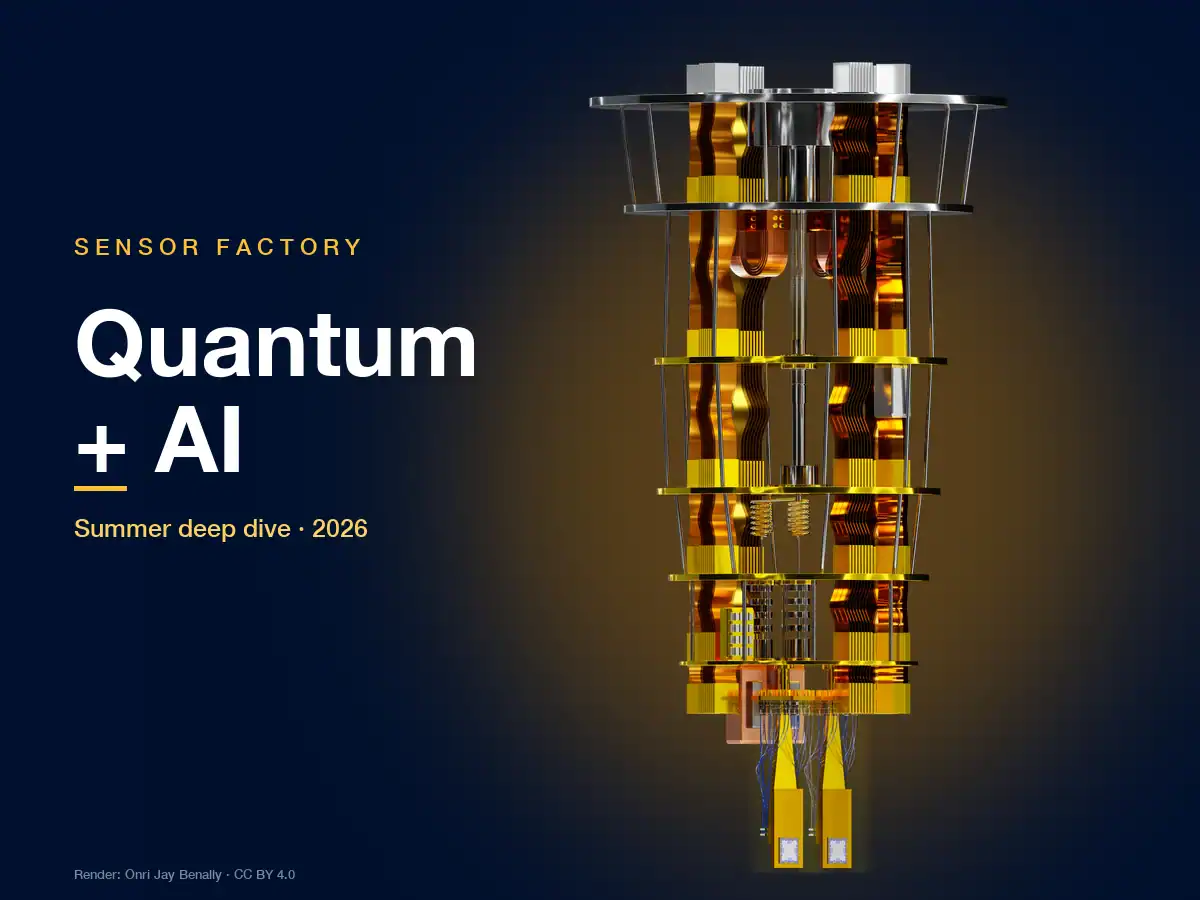
Featured image: render of a quantum-computing cryostat by Onri Jay Benally (OJB Quantum), CC BY 4.0, retouched by Sensor Factory.